


The Agentic Commerce Arms Race
Stripe launched the Machine Payments Protocol (MPP) this week, co-authored with Tempo, their stablecoin spin-off. Visa announced “Agentic Ready” for European issuers. Mastercard’s Agent Pay is live with Santander, PayPal, Fiserv, and half of Europe’s banking sector. Everyone wants to be the payments layer when AI agents start spending your money.
The Bird’s translation: The payments industry just discovered that AI agents can’t fill in a checkout form. So they’ve built seven competing protocols to fix it.
Stripe’s pitch is probably the most ambitious of them all, where MPP is “rail-agnostic” and currently powers agents ordering sandwiches at Prospect Butcher Co. in New York and printing letters via PostalForm. Yes, you read that correctly. The flagship use case for autonomous machine payments is deli orders and postage.

Visa’s Agentic Ready programme claims to have enrolled 20+ issuers including Barclays, HSBC UK, Revolut, and Santander but is still in “controlled production environments” - which means nobody has switched this on for real customers yet.
Mastercard has been the loudest and broadest, partnering with Microsoft for Copilot Checkout, integrating Agent Pay into PayPal’s wallet, and running what they claim was “Europe’s first live end-to-end payment executed by an AI agent” with Santander in early March.
The transaction was some cinema tickets.
The mechanism by which it works: The actual technical problem is straightforward. AI agents can’t authenticate like humans, can’t hold card credentials, and can’t prove consent. So we’ve got Shared Payment Tokens (Stripe), Agentic Network Tokens (Visa/Mastercard), and the Agentic Commerce Protocol (ACP) all trying to solve the same identity-and-permission problem from slightly different angles.
The Victim: Every billing vendor who just finished their MCP integration and thought they were “AI-native.”
The protocols are multiplying faster than the transactions they’re meant to carry. The Bird gives it six months before someone publishes a “Unified Agentic Protocol” that unifies nothing of importance.
🙂↕️ THE BIRD CALLED IT: Both AI giants are now hiring billing teams
Back in January, The Bird predicted that OpenAI would start hiring billing engineers within 2-4 months after Stripe’s acquisition of Metronome left them running their monetisation stack on a strategic frenemy’s infrastructure.
Two months later, both OpenAI and Anthropic are hiring aggressively for billing - with build vs. buy featuring extensively.
OpenAI posted an Order Management & Billing Operations role. The job description is a confession letter. They want someone to “own end-to-end operational readiness for new monetisation launches” and “embed AI and automation directly into Order Management and Billing workflows.” The required experience section lists “Salesforce, Oracle Fusion, NetSuite, Stripe, Metronome“ - now by name.
Read between the lines, OpenAI is building the operational layer to eventually decouple from Metronome. They’re hiring someone who knows the current stack (Stripe + Metronome) but can architect what comes next.
Anthropic is hiring a Director of Order Management & Billing, a Software Engineer for their Billing Platform, and an Engineering Manager for Product Monetisation. Their job posting for the billing engineer says “Anthropic exists to ensure the world safely navigates the transition through transformative AI. That work is funded by commercial revenue, and every dollar of it runs through Billing.”
Anthropic is building a proper billing engineering org from scratch. The Director role reports to the Head of Revenue Accounting and owns “the customer billing lifecycle from contract provisioning through invoice generation.” They also posted a Finance Systems Integration Engineer role. This is a company that’s decided billing is infrastructure, not overhead.
The two largest AI API providers on the planet are both potentially building in-house billing teams at the same time. OpenAI because they can’t afford to have their monetisation layer owned by Stripe. Anthropic because they’re growing fast enough that billing complexity is becoming existential as they look for more international acquirers to reduce payment overhead.

The Billing Angle: Both companies run usage-based billing at a scale that breaks most billing platforms. Billions of API calls. Token-level metering. Enterprise contracts with committed-use agreements layered on top of pay-as-you-go. Credits, overages, tiered pricing, multi-product bundles. If you sell billing software and you’re not terrified that your two biggest potential customers are both building in-house, you’re not paying attention.
The Bird predicted OpenAI would build. Anthropic joining the party is the signal that third-party billing has a shelf life for companies processing at this scale.
✨ SHINY OBJECTS
Stripe is on a roll
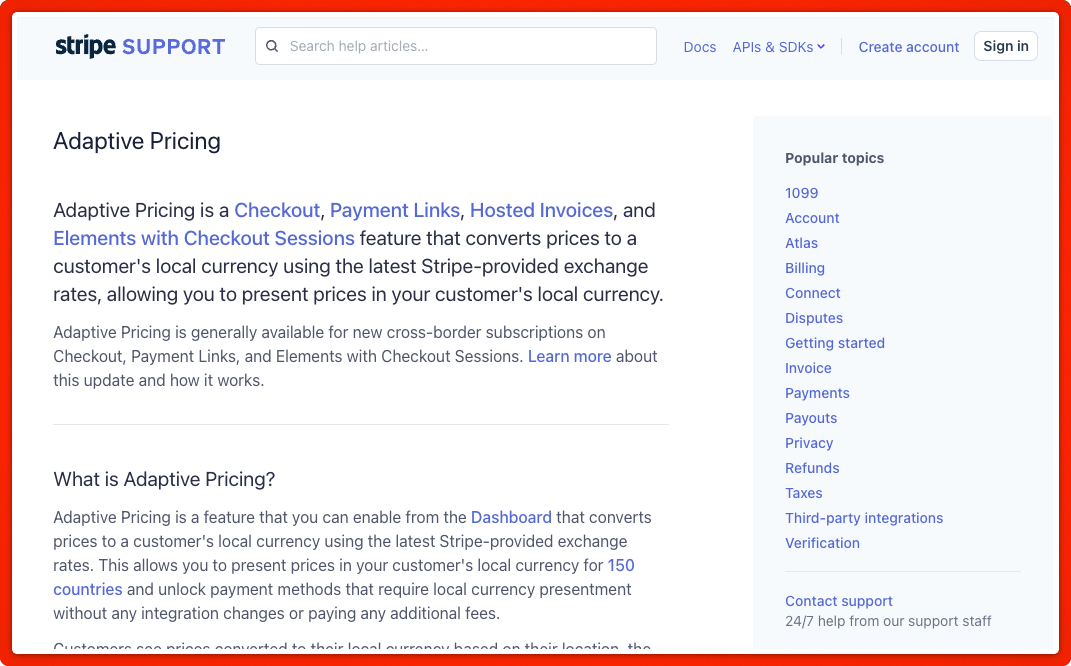
Stripe Adaptive Pricing for Subscriptions
Stripe now auto-localises subscription prices in 150+ countries and claims a 4.7% conversion boost from an A/B test across 1.5 million checkouts.
The Bird’s Verdict: This is Stripe telling Chargebee and Recurly that localisation is a checkbox feature, not a product.
Stripe AI integration benchmark suite
Open-sourced a benchmark suite for testing AI models building Stripe integrations. Covers codebases, data migrations, breaking version changes.
The Bird’s Verdict: Stripe is training the market to benchmark against themselves. If every AI coding assistant optimises for Stripe’s integration tests, guess whose API becomes the default? Smart lock-in disguised as open source.
Maxio’s march kitchen sink
Usage Backdating, Dunning UI overhaul, VAT breakdowns by line item, Apple Pay, Salesforce improvements, NetSuite sync fixes, and another MCP integration because of course.
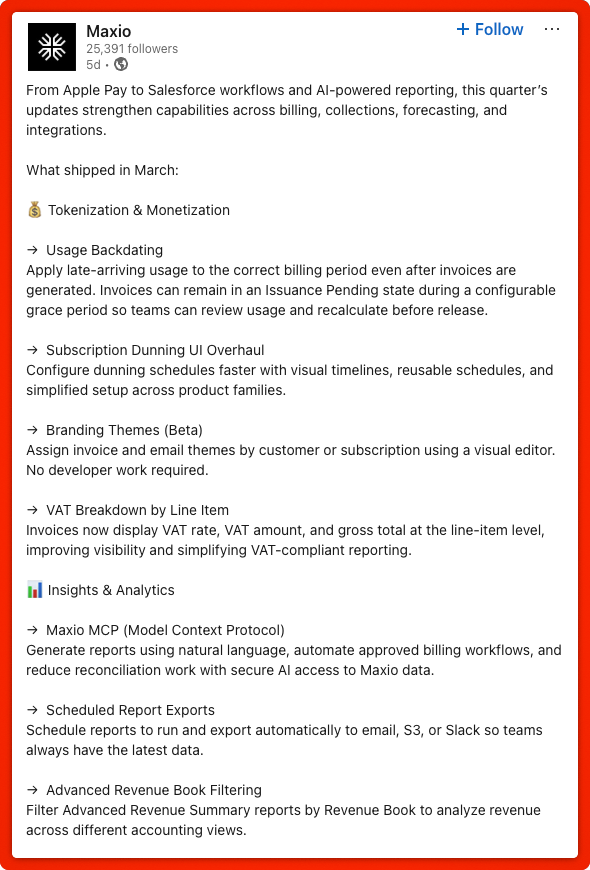
The Bird’s Verdict: Maxio claims to have shipped more features in March than most other vendors ship in a quarter - or at least they’re talking about it. Usage Backdating (applying late usage to the correct billing period) is the kind of boring, essential plumbing that real billing engineers need. The MCP is still a circus checkbox.
The rest is solid mid-market work. Nice work Maxio.
Lago’s enterprise push
Security logs, custom roles and permissions, multiple payment methods per customer, granular API access to charges, webhook filtering. Also hiring 15+ people across Europe and the US.
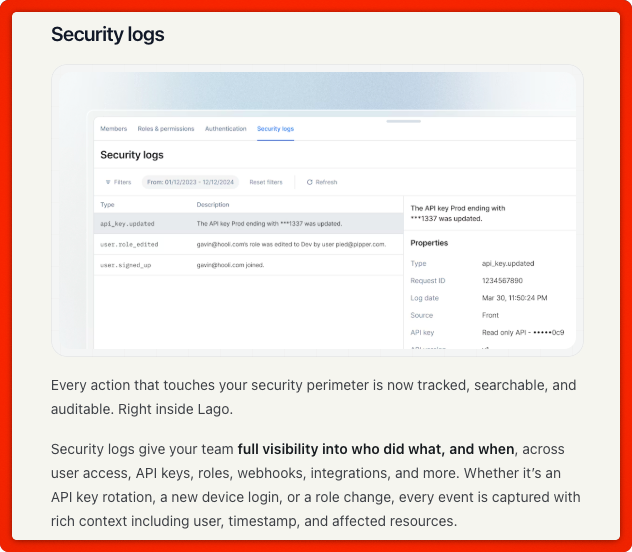
The Bird’s Verdict: Lago is doing the unglamorous work of becoming enterprise-ready. Audit trails searchable via API, webhook filtering by event type, multi-processor support split by geography. This is what enterprise procurement teams actually ask for when they get further in the sales process.
The hiring wave with focus on a Product Engineer building AI Agents is interesting. They’re betting on AI as the interface layer for billing operations.
Solvimon Workflow Feature
Solvimon teases configurable billing lifecycle events with, per their VP Growth, “endless configurability”.
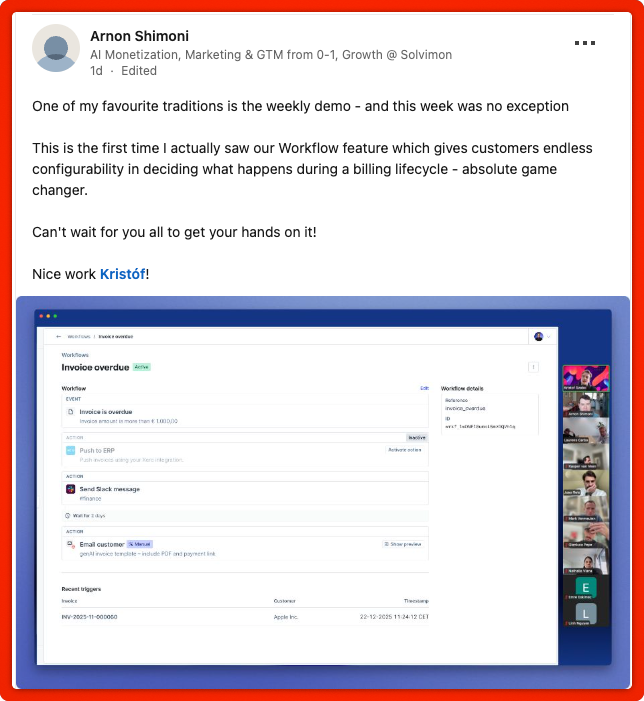
The Bird’s Verdict: The billing lifecycle is where most platforms need extra help from outside platforms. If you can let customers define what happens when a subscription renews, a payment fails, a credit expires, or a usage threshold hits without writing code, you’ve solved one of the hardest UX problems in billing. Worth watching.
🤫 THE SILENT TREATMENT
Missing in Action: Chargebee, Zuora, Paddle, Orb, Amberflo, Younium, Stigg, and Schematic.
Chargebee attended CloudFest and published their “Monetisation Monthly” newsletter. Zuora posted generic marketing. Paddle is a ghost. Orb is quiet. None shipped anything that matters this week.
Chargebee’s silence is entering its third month of being “particularly loud”. At some point, silence stops being strategic and starts being clinical. The market is moving. Stripe owns the usage-based layer now. AI companies are building in-house. And Chargebee is... at CloudFest?
Zuora’s, after their “usage pricing was a mistake, actually” moment in January, they’ve retreated into case studies. The OG subscription platform is watching the world move to hybrid and consumption models without a clear counter-narrative.
🦅 MIGRATION PATTERNS
Recurly hired a new CMO (Suzin Wold) and a Senior Director of Demand Generation (Jen Leaver). When a subscription billing company hires two senior marketing leaders simultaneously, they’re preparing a repositioning campaign. Expect a “Recurly is more than subscriptions” messaging push sometime in Q2.
Polar is hiring across compliance, payments engineering, platform engineering, and technical support. Transactions grew 50% month-over-month in February. 7,000+ new merchant signups monthly. They hosted a hackathon with Lovable in Stockholm. Polar is the quiet one that’s actually growing.
Lago is hiring 15+ across Europe and the US, with specific callouts for a Product Engineer building AI Agents, Product Marketing, Sales, and FP&A/RevOps. Nearing 50 employees. The open-source billing darling is scaling its commercial engine.
🏆 THE MOST BORING UPDATE AWARD
Dodo Payments rebuilt their website. Migrated off Framer. Rewrote it in Astro. “Ships zero JavaScript by default.”
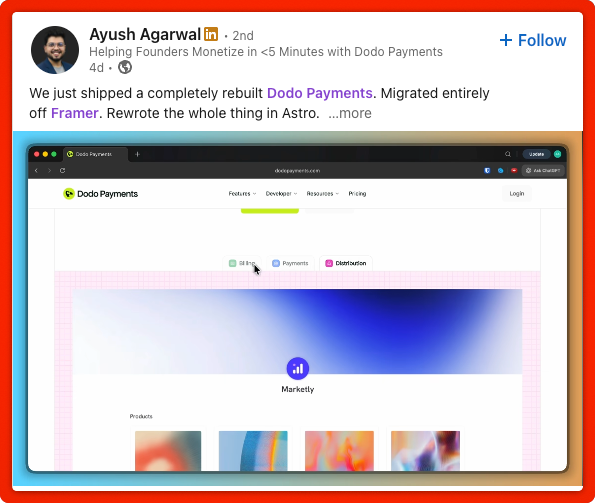
Congratulations. Your billing company now has a fast website. The Bird is overwhelmed with emotion.
Our final word
Is the agentic commerce gold rush is the MCP circus all over again, just with bigger logos attached? Stripe, Visa, and Mastercard are all building protocols for a future where AI agents buy things autonomously. The use cases so far are underwhelming.
Both OpenAI and Anthropic hiring billing teams at the same time tells you that the third-party billing market has a ceiling, and the biggest customers in the world just bumped their heads on it.
Stay on the wire.
- The Billing Bird